What Is Traditional Radiation Therapy?
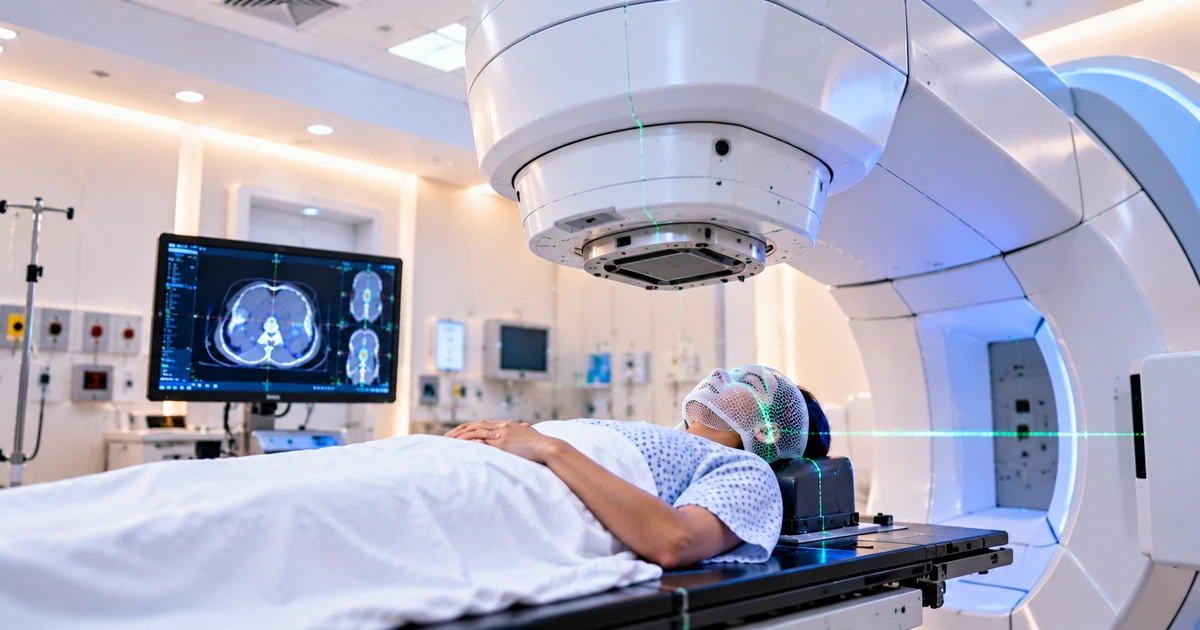
Traditional radiation therapy, often called conventional radiation or 3D Conformal Radiation Therapy (3D-CRT), has been the clinical standard for decades. High-energy X-rays are delivered from a few fixed angles to destroy cancer cells. Modern versions include Intensity-Modulated Radiation Therapy (IMRT) and Volumetric Modulated Arc Therapy (VMAT), which shape the dose more precisely than older techniques.
Traditional radiation is typically given in these forms:
- External Beam Radiation Therapy (EBRT): Delivered by a linear accelerator (LINAC) from outside the body. Modern EBRT includes IMRT and VMAT.
- Internal Radiation (Brachytherapy): Radioactive sources placed inside or next to the tumour, commonly used for cervical, prostate, and some breast cancers.
- Systemic Radiation Therapy: Radioactive substances such as Iodine-131 given orally or intravenously, used mainly in thyroid cancer and some bone metastases.
Traditional radiation, in its modern IMRT and VMAT forms, remains highly effective for the majority of cancer patients across the world.
What Is TomoTherapy Radiation?
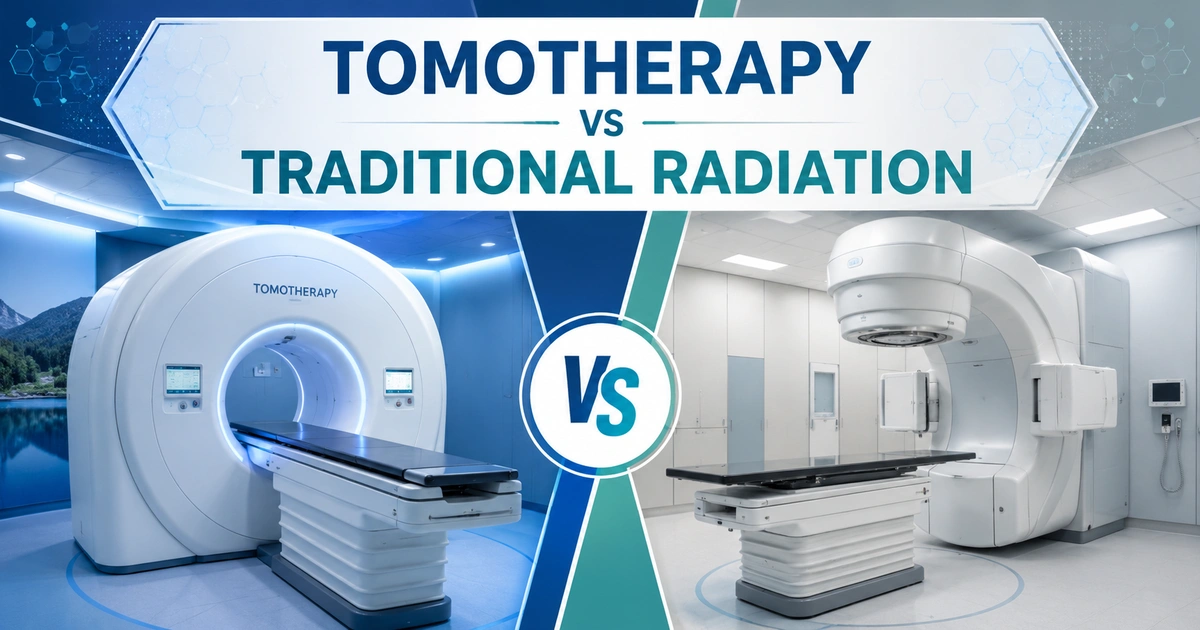
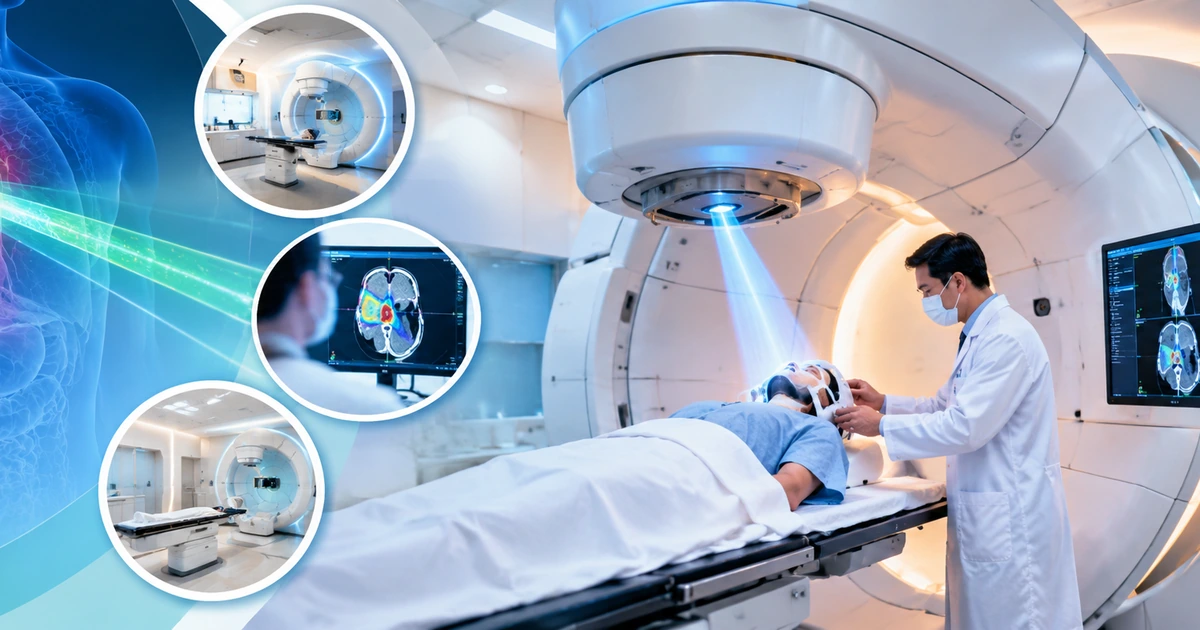
TomoTherapy is a specialised form of image-guided IMRT delivered on a machine that looks similar to a CT scanner. Instead of firing radiation from a few fixed angles, TomoTherapy rotates 360 degrees around the patient in a helical pattern while the treatment couch moves slowly through the machine. Radiation is delivered as thousands of small beamlets shaped to match the exact 3D outline of the tumour.
Key features include:
- Integrated daily CT imaging. A CT scan is done on the treatment machine before every session to confirm the tumour position on that day.
- Helical delivery. Radiation reaches the tumour from all angles, giving high conformity and better sparing of healthy tissue.
- Multi-site treatment. Multiple tumours or long anatomical areas (for example, the craniospinal axis) can be treated in one setup.
- Adaptive planning. The plan can be adjusted as the tumour shrinks or the patient’s weight changes over the course of treatment.
Onco-Life Cancer Centre houses a TomoTherapy Radixact system with Synchrony motion tracking at its Talegaon centre (Pune region).
TomoTherapy vs Traditional Radiation at a Glance
|
Feature
|
Traditional Radiation (3D-CRT / IMRT / VMAT)
|
TomoTherapy
|
|
Beam delivery
|
Fixed angles or arc
|
360-degree helical rotation
|
|
Image guidance
|
Kilovoltage CBCT (in most modern LINACs)
|
Daily megavoltage CT on the treatment machine
|
|
Precision for complex shapes
|
Very good with IMRT/VMAT
|
Excellent for concave or wrap-around targets
|
|
Multiple tumour sites in one session
|
Possible but complex
|
Efficient in a single plan
|
|
Session time
|
Approximately 10–20 minutes
|
Approximately 15–30 minutes
|
|
Availability
|
Widely available across India
|
Available at select centres
|
|
Suitability
|
Almost all cancer types
|
Complex-shape tumours, re-irradiation, multi-site cases
|
Both technologies can achieve excellent clinical outcomes. The right choice depends on the specific tumour, its shape, its location, and prior treatments.
Advantages of TomoTherapy
- Superior conformity. The rotating beam wraps radiation precisely around complex or concave tumour shapes, sparing critical organs such as the spinal cord, salivary glands, or optic nerves.
- Excellent for multi-site treatment. Long anatomical areas or multiple tumours can be treated in a single plan without joining separate beam setups.
- Daily image-guided accuracy. A fresh CT is taken every session, so radiation is delivered on the anatomy as it is today, not a week ago.
- Useful for re-irradiation. In carefully selected patients, TomoTherapy allows repeat radiation to previously treated areas with fewer complications.
- Reduced radiation to healthy tissue in many complex cases, which may translate into fewer long-term side effects.
Disadvantages and Limitations of TomoTherapy
TomoTherapy is not automatically the best choice for every patient. Its limitations include:
- Longer session time. Each session is a few minutes longer than a standard IMRT or VMAT session, which can be a challenge for patients who cannot lie still comfortably.
- Higher cost per course. TomoTherapy typically costs more than conventional radiation, though this can be reduced under government schemes.
- Limited availability. TomoTherapy machines are installed at select centres, so patients may need to travel to access it.
- Not always superior. For simple, well-defined tumours, modern IMRT or VMAT on a standard LINAC can deliver equally good results in less time.
- Higher low-dose spread. Because radiation is delivered from all angles, a low dose reaches a larger volume of healthy tissue. Your radiation oncologist and physicist weigh this against the benefits of tight high-dose conformity.
- Metal implants may cause artefacts on the daily CT, requiring additional planning steps.
Advantages of Traditional Radiation Therapy
- Decades of clinical evidence. 3D-CRT, IMRT, and VMAT have well-established outcomes across almost every cancer type.
- Shorter session time. Sessions are typically 10 to 20 minutes, which suits many patients.
- Widely accessible. Available at most cancer centres, often at a lower cost.
- Excellent for many standard cases. For breast cancer, prostate cancer, many head and neck cancers, and lung cancer, modern LINAC-based IMRT or VMAT is highly effective.
Side Effects Compared
Both TomoTherapy and traditional radiation share the same common side effects, which depend on the area treated:
- Skin redness or irritation over the treatment area
- Fatigue, which often builds through the course
- Hair loss in the treated area only
- Mouth ulcers, dry mouth, or difficulty swallowing (head and neck radiation)
- Cough, breathlessness, or oesophagitis (chest radiation)
- Nausea, diarrhoea, or urinary symptoms (abdominal or pelvic radiation)
Because TomoTherapy delivers less high-dose radiation to healthy tissue in many complex cases, some patients experience fewer or milder long-term side effects. However, the overall side effect profile is similar for the majority of standard cancers. Your team monitors and manages side effects weekly during treatment.
TomoTherapy vs IMRT, VMAT, LINAC, and Proton Therapy
TomoTherapy vs IMRT IMRT delivers radiation from a few fixed angles with dose modulation. TomoTherapy is a helical form of IMRT that rotates continuously around the patient. Both aim for the same goal, but TomoTherapy often gives better dose shaping around irregular targets.
TomoTherapy vs VMAT VMAT is delivered on a standard LINAC and moves in one or two arcs. It is fast and highly effective. TomoTherapy uses continuous 360-degree helical delivery and often integrates daily CT imaging. For complex shapes or multiple sites, TomoTherapy has an edge; for many standard cancers, VMAT is equally effective and quicker.
TomoTherapy vs LINAC “LINAC” refers to the machine that delivers most external beam radiation, including IMRT, VMAT, and stereotactic radiosurgery. TomoTherapy is essentially a specialised LINAC with helical delivery and integrated CT. It is one option within the broader LINAC family.
TomoTherapy vs Proton Therapy Proton therapy uses charged particles instead of X-rays, and deposits most of its dose at a precise depth (the Bragg peak). It reduces exit dose beyond the tumour and is particularly useful for paediatric cancers and tumours near critical structures. Proton therapy is available at very few centres in India and is significantly more expensive. TomoTherapy remains an excellent, widely accessible option for most patients.
Which Radiation Technique Is Right for You?
The choice is rarely about which is universally “better,” but about which is best suited to your specific tumour. Your radiation oncologist typically considers:
- Tumour location and shape. Complex, concave, or multi-site targets often favour TomoTherapy.
- Proximity to critical organs. Tumours near the spinal cord, optic nerves, brainstem, or salivary glands may benefit from TomoTherapy’s dose sparing.
- Prior radiation. Re-irradiation of a previously treated area often uses TomoTherapy.
- Field length. Long areas such as craniospinal radiation are often more efficient on TomoTherapy.
- Ability to lie still. Patients who find longer sessions difficult may do better with shorter VMAT sessions.
- Availability and cost considerations. Government scheme eligibility, insurance coverage, and travel practicalities all play a role.
Before your first session, your radiation oncologist and medical physicist use dosimetry software to plan both options where relevant, comparing dose distribution to the tumour and to nearby healthy tissue. The plan that gives the safest, most effective coverage is selected.
Cost in India and Insurance Coverage
Radiation therapy cost in India depends on the technique, the number of fractions, and the treatment site.
- Conventional radiation (3D-CRT / IMRT / VMAT): approximately ₹90,000 to ₹3,00,000 for a full course
- TomoTherapy: approximately ₹2,50,000 to ₹6,50,000 or more for a full course, depending on complexity and duration
These are indicative figures. Actual costs vary by centre, treatment plan, and additional services.
Financial support may be available through:
- Mahatma Jyotirao Phule Jan Arogya Yojana (MJPJAY) — Maharashtra state scheme
- Ayushman Bharat (PM-JAY) — national scheme
- CGHS — for central government employees
- Private health insurance, subject to policy terms
- GIPSA cashless insurance for empanelled insurers
Onco-Life is empanelled under MJPJAY, PM-JAY, and CGHS. Eligibility criteria apply; please check government scheme eligibility before starting treatment.
Radiation Care at Onco-Life
Onco-Life Cancer Centre offers a full spectrum of radiation technology, from 3D-CRT, IMRT, and VMAT to TomoTherapy Radixact with Synchrony and brachytherapy. Treatment planning is discussed jointly with surgical and medical oncologists at the Virtual Tumour Board.
Radiation services are available across the Onco-Life network:
To discuss which radiation technique is best for your cancer, please Book a Doctor Appointment with our radiation oncology team, or request a Second Opinion on an existing radiation plan.
DISCLAIMER
This article is for informational purposes only and is not a substitute for professional medical advice, diagnosis, or treatment. Always seek the guidance of a qualified healthcare provider with any questions regarding a medical condition.