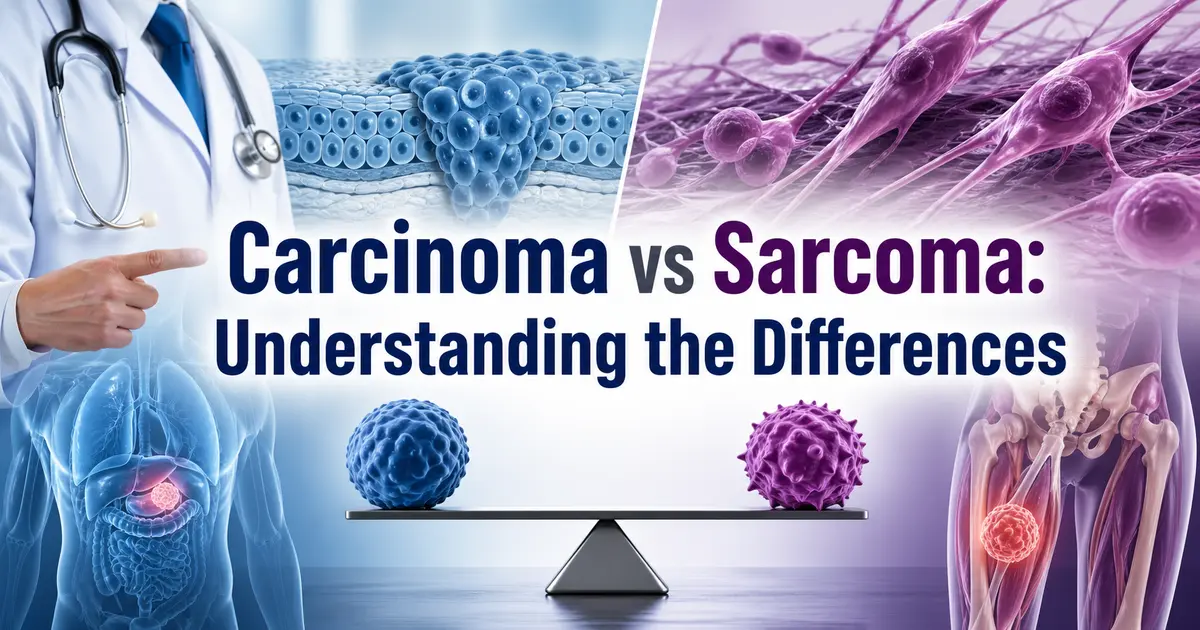
Carcinomas and sarcomas are both cancers, but they originate from different types of cells. Carcinoma develops from epithelial cells (skin, lungs, breast, digestive organs), while sarcoma develops from connective tissues (bone, muscle, fat, cartilage). Understanding these differences is essential for diagnosis, treatment, and prognosis.
Together, carcinomas and sarcomas account for over 95% of all malignant cancers. Carcinomas represent approximately 85% of all cancers; sarcomas are rarer, comprising only 1-2% of adult cancers but are more common in children.
Carcinoma vs. Sarcoma: Side-by-Side Comparison
|
Characteristic
|
Carcinoma
|
Sarcoma
|
|
Cell Origin
|
Epithelial cells (skin, lungs, liver, breast, colon)
|
Mesenchymal (connective tissue: bone, muscle, fat, cartilage)
|
|
Frequency
|
85% of all cancers
|
1-2% of adult cancers, 10% of childhood cancers
|
|
Age of Onset
|
Typically adults 40+
|
Can occur at any age; common in children/young adults
|
|
Common Types
|
Adenocarcinoma, squamous cell, basal cell
|
Osteosarcoma, rhabdomyosarcoma, liposarcoma, fibrosarcoma
|
|
Typical Location
|
Lung, breast, prostate, colon, pancreas, skin
|
Leg bones, arm bones, soft tissues near joints
|
|
Spread Pattern
|
Often spreads to lymph nodes first
|
Direct bloodstream spread (lung metastasis common)
|
|
Metastasis Rate
|
Variable by type and stage
|
Higher propensity for distant metastasis
|
|
Prognosis
|
Variable; often better with early detection
|
Variable; histological grade critical
|
|
Treatment
|
Surgery, radiation, chemotherapy, targeted therapy
|
Surgery, chemotherapy, radiation, immunotherapy
|
|
5-Year Survival
|
Highly variable by type (30-90%)
|
Highly variable (30-70%+)
|
|
Key Difference
|
Originates from body surface/organ linings
|
Originates from deep connective tissues
|
What Is Carcinoma? Detailed Explanation
Carcinoma is a malignant tumour arising from epithelial cells – the cells that line the body surfaces and organs. These cells form the skin, lungs, breast tissue, lining of the digestive tract, liver, pancreas, and other organs.
Common Types of Carcinoma:
- Adenocarcinoma: Arises from glandular epithelial cells – breast, pancreas, lung, colon cancers
- Squamous Cell Carcinoma: Arises from flat squamous cells – skin, lung, head & neck
- Basal Cell Carcinoma: Most common skin cancer, arises from basal layer
- Melanoma: Arises from melanocytes (pigment cells) – aggressive form
- Hepatocellular Carcinoma: Arises from liver cells
Carcinomas account for 85% of all human cancers. Adenocarcinomas are the most common type overall.
What Is Sarcoma? Detailed Explanation
Sarcoma is a malignant tumour arising from mesenchymal (connective) tissues – bone, cartilage, muscle, fat, blood vessels, and nerves. Unlike carcinomas that develop on the body surface, sarcomas develop deep within tissues.
Common Types of Sarcoma:
- Osteosarcoma: Arises from bone – most common in children & young adults
- Rhabdomyosarcoma: Arises from skeletal muscle – most common paediatric sarcoma
- Liposarcoma: Arises from fat tissue
- Ewing’s Sarcoma: Arises from bone or bone marrow
- Fibrosarcoma: Arises from fibrous tissue
- Leiomyosarcoma: Arises from smooth muscle
Sarcomas are rare, comprising only 1-2% of adult cancers but 10% of childhood cancers. High-grade sarcomas tend to grow quickly and spread early.
How Are Carcinoma and Sarcoma Diagnosed?
Diagnosis Process:
- Imaging: CT, MRI, ultrasound, or X-ray to locate and characterise the tumour
- Biopsy: Tissue sample obtained to determine exact cell type and grade
- Pathology Report: Definitively identifies whether tumour is carcinoma or sarcoma
- Staging: TNM staging (tumour size, node involvement, metastasis)
- Accurate pathological diagnosis is critical – it determines treatment approach, prognosis, and clinical outcomes.
Treatment: Carcinoma vs. Sarcoma
Carcinoma Treatment:
- Surgery – primary modality for localised disease
- Radiation Therapy – adjuvant or standalone
- Chemotherapy – for advanced/metastatic disease
- Targeted Therapy – for specific mutations
- Immunotherapy – for selected carcinomas
Sarcoma Treatment:
- Chemotherapy – Often first-line (neoadjuvant)
- Surgery – Resection with wide margins
- Radiation Therapy – Adjuvant or when surgery not possible
- Targeted Therapy – For specific sarcoma subtypes
Prognosis: Carcinoma vs. Sarcoma
Prognosis depends on multiple factors for both carcinoma and sarcoma: tumour grade, stage, location, patient age, and access to advanced treatment. Early detection and comprehensive treatment planning significantly improve outcomes.
DIAGNOSED WITH CARCINOMA OR SARCOMA?
Our expert oncologists provide comprehensive diagnosis, staging, and treatment planning for all cancer types.
Schedule your oncology consultation at Onco-Life Cancer Centre – Talegaon, Satara, Chiplun, or Wagholi
About Onco-Life Cancer Centre
Onco-Life Cancer Centre is Maharashtra’s largest dedicated oncology hospital network with three NABH accreditations and NCG membership. We treat over 1,20,000 patients across four centres, offering comprehensive oncological care for all cancer types including carcinomas and sarcomas.
Our multidisciplinary teams provide expert pathology, imaging, surgery, radiation oncology, medical oncology, and supportive care services.
DISCLAIMER
This article is for informational purposes only and is not a substitute for professional medical advice, diagnosis, or treatment. Always seek the guidance of a qualified healthcare provider with any questions regarding a medical condition.