
Onco Life Hospitals

Tomotherapy vs. Traditional Radiation: Which is Right for You?

When facing a cancer diagnosis, choosing the right treatment is a pivotal decision. Among the various options, radiation therapy remains a cornerstone of curative and palliative care due to the many advantages of radiation therapy in cancer treatment. However, “radiation” is not a single treatment, but a suite of evolving technologies ranging from conventional techniques to advanced platforms like Tomotherapy [1]. Understanding the nuances between these options can help you engage in a more informed dialogue with your clinical team.

What is Traditional Radiation Therapy?

Traditional radiation therapy, often referred to as conventional or 3D-Conformal Radiation Therapy (3D-CRT), has been the clinical standard for decades. This method involves directing high-energy X-rays at the malignancy to inhibit cancer cell division. While modern “traditional” therapy is highly digitalized, it typically delivers radiation from a few fixed angles [2].

Traditional radiation can be delivered in several ways:

  • External Beam Radiation Therapy (EBRT): The most frequent form, where a linear accelerator (LINAC) delivers beams from outside the body. Modern EBRT often utilizes Intensity-Modulated Radiation Therapy (IMRT) to vary the dose across each beam [3].
  • Internal Radiation Therapy (Brachytherapy): Involves placing radioactive “seeds” or sources directly into or near the tumor. This is commonly used for localized cancers such as prostate, cervical, and breast cancers.
  • Systemic Radiation Therapy: Uses unsealed radioactive substances (like Iodine-131) administered orally or intravenously to target specific cells, such as in thyroid or certain bone cancers.

What is Tomotherapy Radiation for Cancer Treatment?

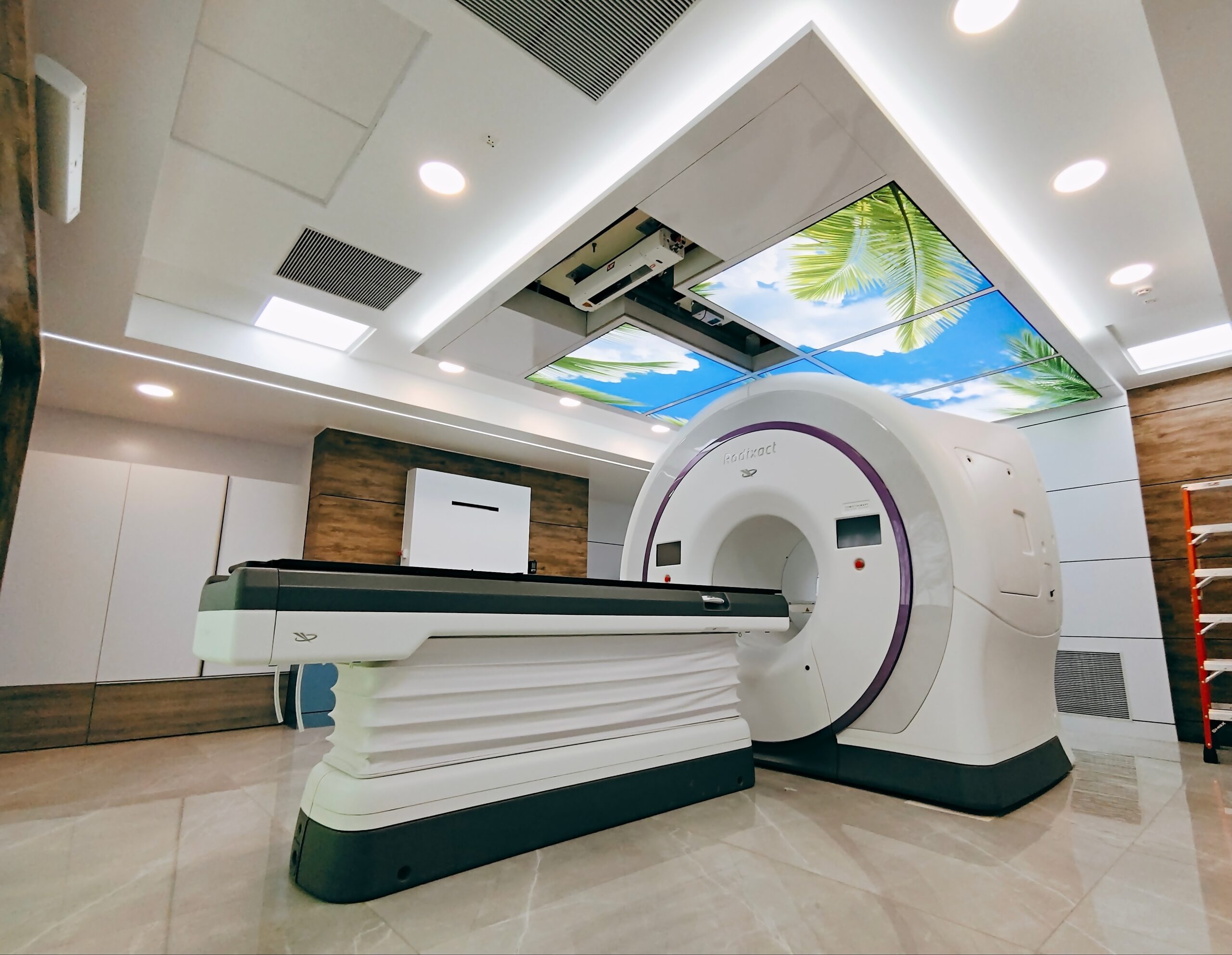
Tomotherapy is a specialized form of IMRT that integrates the precision of a CT scanner with a radiation delivery system. Unlike a standard LINAC that moves in large arcs, Tomotherapy uses a helical (spiral) delivery system, meaning the radiation rotates 360 degrees around the patient while the treatment couch moves slowly through the machine [4].

Key features include:

  • Integrated CT Scanning (IGRT): A “megavoltage” CT scan is performed immediately before every session to verify the tumor’s exact position, accounting for daily internal organ movement or minor weight changes [5].
  • Helical Delivery: This allows for thousands of “beamlets” to target the tumor from all angles, enabling the treatment of large areas or multiple tumors simultaneously without stopping the machine.
  • Real-Time Adaptive Planning: Clinicians can adjust the beam intensity in real-time to ensure the highest dose reaches the tumor while sparing adjacent healthy tissue.

Advantages of Tomotherapy Radiation

  • Superior Conformity: Because the beam rotates 360 degrees, it can more accurately “wrap” the radiation dose around complex-shaped tumors located near critical organs, such as the spinal cord or salivary glands [4].
  • Treatment of Multiple Sites: It is uniquely efficient at treating long areas (like the entire craniospinal axis) without the need to “stitch” multiple beam setups together.
  • Reduced Toxicity Risk: By minimizing the “scatter” radiation to healthy organs, patients may experience a reduction in long-term side effects compared to older conventional methods [6].

Advantages of Traditional Radiation Therapy

  • Clinical Longevity: 3D-CRT and standard IMRT have decades of robust data confirming their efficacy across nearly all tumor types.
  • Efficiency: Standard EBRT sessions are often faster (sometimes 5–15 minutes), which may be preferable for patients who have difficulty lying still for extended periods.
  • Widespread Accessibility: It is the global standard of care and is available in almost every oncology center, often at a lower cost to the patient or insurer.

Which is Right for You?

The choice between Tomotherapy and traditional radiation is rarely about which is “better” in a vacuum, but rather which is more appropriate for your specific tumor anatomy [1]. Consider the following:

  • Tumor Location: If a tumor is near a “critical structure” (like the optic nerve), the 360-degree precision of Tomotherapy may be advantageous.
  • Field Size: For simple, localized tumors, traditional EBRT is highly effective and efficient.
  • Prior Radiation: Tomotherapy is often preferred for “re-irradiation” cases where a patient needs treatment in an area that has previously received radiation [5].

Consultation with Your Oncologist

Your radiation oncologist (Dr. Jyoti Mehta) will use sophisticated “dosimetry” software to model both options before your first session. They will evaluate the Dose-Volume Histogram (DVH) to see which technology provides the safest coverage for your specific case [6].

At Onco-Life Cancer Center, we offer a comprehensive spectrum of technologies, from high-precision EBRT to Tomotherapy. Our goal is to tailor the technology to the patient, not the other way around.

Our multidisciplinary oncology team across locations is listed below for your consultation reference.

Disclaimer

This content is for informational purposes only and does not constitute medical advice, diagnosis, or treatment. Always seek the advice of your physician or other qualified health provider with any questions you may have regarding a medical condition. Never disregard professional medical advice or delay in seeking it because of something you have read on this website.

References

Frequently Asked Questions (FAQs)

Blog – Tomotherapy vs. Traditional Radiation: Which is Right for You?

Is Tomotherapy More Painful Than Traditional Radiation?

No. Both treatments are non-invasive and painless, similar to getting a standard X-ray.

How Long Does A Tomotherapy Session Take Compared To Ebrt?

Tomotherapy sessions usually take 15–20 minutes, slightly longer than standard EBRT due to the integrated daily CT scan.

Does Insurance Cover Tomotherapy?

Most major insurance providers cover Tomotherapy when it is deemed medically necessary (e.g., for tumors near critical organs), though prior authorization is usually required.

Is Tomotherapy Safer Than Traditional Radiation Therapy?

Yes, Tomotherapy generally reduces radiation exposure to nearby healthy tissues.

Who Should Choose Tomotherapy Treatment?

Patients with complex or hard-to-reach tumors often benefit most from Tomotherapy’s precision.

Does Tomotherapy Have Fewer Side Effects?

In many cases, Tomotherapy causes fewer side effects because it targets tumors more accurately.

Leave a Reply

Your email address will not be published. Required fields are marked *

Latest Post

Newsletter

Signup our newsletter to get free update, news or insight.