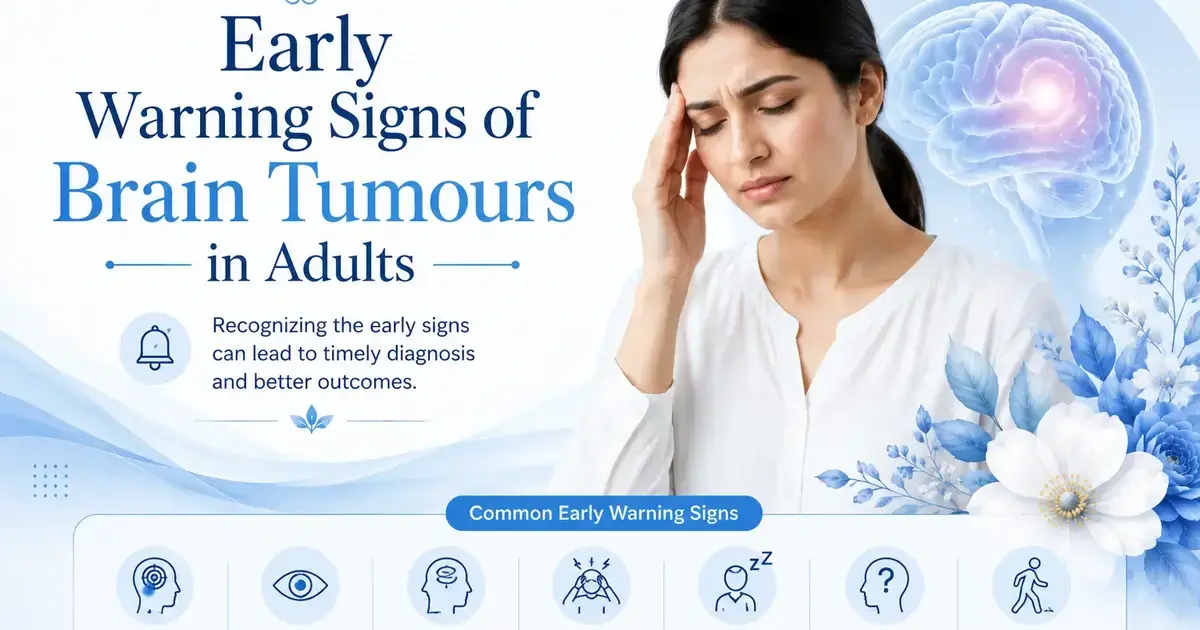
The early warning signs of a brain tumour in adults often include new or changing headaches, seizures, vision or speech changes, and problems with memory, balance, or movement. Most of these symptoms have common, harmless causes, but when they are new, persistent, or appear together, they should be checked by a doctor. Recognising brain tumour symptoms early can lead to a faster diagnosis and more treatment options.
If you or someone close to you is worried about these symptoms, this guide explains what to look for and what happens next. At Onco-Life Cancer Centre, a specialist team will help you understand your situation and your options at every step.
What Is a Brain Tumour?
A brain tumour is a growth of abnormal cells in or around the brain. Brain tumours can be benign (non-cancerous) or malignant (cancerous), and they may start in the brain (primary) or spread to the brain from another organ (secondary).
Because different parts of the brain control different functions, the effect of a tumour depends on where it is and how large it is. This is why the signs of a brain tumour can vary so much from one person to another.
Common Brain Tumour Symptoms in Adults
Brain tumour symptoms depend on the size and location of the tumour. The following are among the more common early warning signs to be aware of:
- Headaches: New headaches, or a change in your usual pattern, that may be worse in the morning, when lying down, or when coughing or straining.
- Seizures: A first-ever seizure in an adult is an important warning sign.
- Nausea or vomiting: Especially in the morning and alongside a headache.
- Vision changes: Blurred or double vision, or loss of side (peripheral) vision.
- Speech or language difficulty: Trouble finding words or understanding others.
- Memory and thinking changes: Confusion, poor concentration, or a change in personality or behaviour.
- Weakness or numbness: Often on one side of the body.
- Balance and coordination problems: Unsteadiness, dizziness, or clumsiness.
- Hearing loss: Usually on one side.
A single symptom on its own is rarely due to a brain tumour. The concern is greater when a symptom is new, keeps getting worse, or when several of these signs appear together.
When to See a Doctor
See a doctor promptly if you have a new and persistent headache that is different from your usual headaches, a first seizure, or neurological symptoms such as weakness, vision loss, or speech difficulty that do not settle. These signs do not confirm a brain tumour, but they do need to be assessed without delay. Several brain tumour symptoms appearing together, or one that steadily worsens, deserve prompt medical attention.
Early assessment matters. Finding the cause early gives you the widest range of treatment choices and peace of mind if the cause turns out to be something minor.
How Brain Tumours Are Diagnosed: The Role of the MRI Scan
If your brain tumour symptoms suggest a problem, the first step is usually a neurological examination, followed by imaging of the brain. An MRI (Magnetic Resonance Imaging) scan is the main test used.
So what is an MRI scan? It is a scan that uses a strong magnetic field and radio waves, rather than X-rays, to create detailed pictures of the soft tissues of the brain. Because it does not use ionising radiation and shows fine detail, it is very well suited to looking at the brain.
What is an MRI scan used for in this setting? It helps doctors find a tumour, show its exact size and location, plan surgery or radiation, and monitor the brain after treatment. The main benefits of an MRI scan are its clear soft-tissue detail, the absence of radiation, and its ability to detect small changes early. You can learn more about our MRI and diagnostic imaging services.
In some cases, a CT scan, a PET-CT scan, or a biopsy is also used to confirm the diagnosis and identify the exact type of tumour.
Treatment Options for Brain Tumours
Treatment depends on the type, grade, size, and location of the tumour, and on your general health. Options may be used alone or together and include:
- Surgery: To remove as much of the tumour as safely possible, or to take a sample for diagnosis.
- Radiation therapy: Including precise techniques such as stereotactic radiosurgery, which targets the tumour while limiting the dose to healthy brain tissue.
- Chemotherapy and targeted therapy: Medicines used for certain tumour types, often alongside other treatments.
- Supportive care: Including steroids to reduce swelling around the tumour and care to manage symptoms.
At Onco-Life, every case is reviewed by a tumour board of specialists, so your plan reflects the type and location of your tumour and is agreed by the whole team before treatment begins.
Free and Government-Supported Cancer Treatment
A serious diagnosis brings worry about cost as well as health. No hospital provides cancer treatment completely free from its own funds, which is why many families search for free cancer treatment. What makes low-cost or cashless treatment possible is government health schemes that cover eligible patients, and brain tumour surgery is among the procedures these schemes can cover.
- Mahatma Jyotirao Phule Jan Arogya Yojana (MJPJAY): a Maharashtra scheme offering cashless treatment for eligible families at empanelled hospitals.
- Ayushman Bharat (PM-JAY): a national scheme that covers many cancer treatments for eligible families.
- Central Government Health Scheme (CGHS): for serving and retired central government employees and their dependants.
Whether you qualify depends on your income, family details, and documents. Eligibility criteria apply; please verify your eligibility before visiting the hospital. Onco-Life’s coordinators can check your eligibility and handle the paperwork. Learn more about free cancer treatment under government schemes at Onco-Life.
When to Consult a Specialist
A brain tumour diagnosis, or the wait for one, is frightening. You do not have to face it alone. If brain tumour symptoms are worrying you, or you have a scan that needs review or a diagnosis from elsewhere, our team can review your reports and offer a second opinion.
Patients travelling from the Mumbai region can start by consulting our cancer specialists near Mumbai.
Disclaimer
This content is for informational purposes only and does not constitute medical advice. The signs, diagnosis, and treatment of brain tumours vary from person to person. Please consult a qualified doctor or oncologist for diagnosis and treatment decisions.
Book a Consultation
If you or a loved one is worried about the warning signs of a brain tumour, our specialists can help you understand the next steps. Book a consultation with our oncologists or request a second opinion today.
Frequently Asked Questions