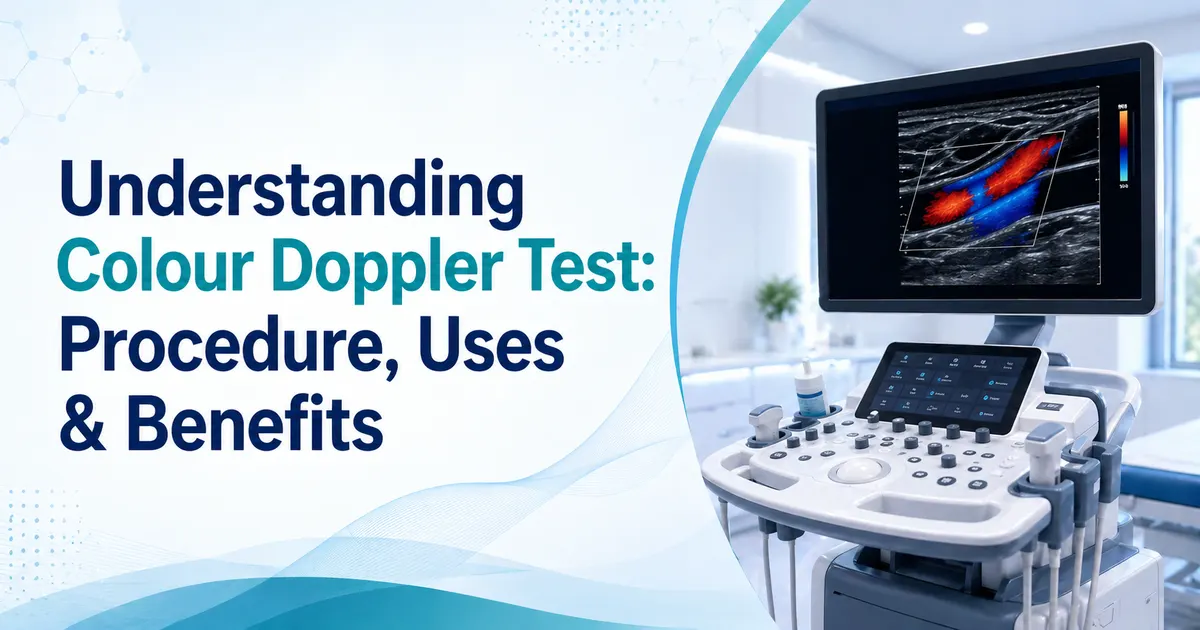
What is a Colour Doppler Test?
A colour Doppler test is a type of ultrasound examination that shows both the structure of internal organs and the direction and speed of blood flow through them – all in real time and without radiation. The coloured display shows blood moving towards the probe in red and blood moving away from the probe in blue. The colours do not indicate anything harmful; they are simply a visual map of blood movement.
A colour Doppler test is non-invasive, painless, and suitable for patients of all ages. It is used by doctors to investigate heart conditions, vascular problems, pregnancy and fetal well-being, and the blood supply to organs and tumours. At Onco-Life Cancer Centre, it forms part of the cancer diagnostic and monitoring pathway whenever blood flow to a suspicious mass or organ needs to be assessed.
| कलर डॉपलर टेस्ट क्या होता है? (Colour Doppler Test in Hindi)
कलर डॉपलर एक विशेष प्रकार का अल्ट्रासाउंड टेस्ट है जो शरीर के अंदर रक्त प्रवाह (Blood Flow) को रंगीन छवियों में दिखाता है। यह टेस्ट बिना किसी दर्द, सुई, या एक्स-रे के किया जाता है। इसका उपयोग हृदय, नसों, धमनियों, गर्भावस्था और ट्यूमर में रक्त आपूर्ति की जांच के लिए किया जाता है।
अगर आपके डॉक्टर ने कलर डॉपलर टेस्ट की सलाह दी है, तो Onco-Life Cancer Centre, महाराष्ट्र में यह सुविधा उपलब्ध है। अपॉइंटमेंट के लिए: 8128124067 (तालेगांव / वाघोली) | 7769004343 (सतारा) | 7378958000 (चिपलून)
ডপলার টেস্ট কী? (Bengali — ডপলার টেস্ট কি)
কালার ডপলার একটি বিশেষ আল্ট্রাসাউন্ড পরীক্ষা যা শরীরের ভেতরে রক্ত প্রবাহ রঙিন ছবিতে দেখায়। এই পরীক্ষা ব্যথামুক্ত এবং এক্স-রে ছাড়া করা হয়। |
How Does a Colour Doppler Ultrasound Work?
The machine sends high-frequency sound waves into the body through a handheld probe placed on the skin. When these waves reach moving red blood cells, they bounce back at a slightly different frequency – this is the Doppler effect, the same principle that makes an ambulance siren sound higher-pitched as it approaches and lower-pitched as it moves away.
The ultrasound system converts these frequency changes into a real-time, colour-coded image. The result is a dynamic map of blood movement layered on top of the standard greyscale ultrasound picture.
What Do the Red and Blue Colours Mean on a Colour Doppler?
On a colour Doppler image, the colours represent the direction of blood flow relative to the ultrasound probe – not whether the blood is oxygenated or whether a finding is normal or abnormal.
- Red indicates blood flowing towards the probe.
- Blue indicates blood flowing away from the probe.
- Shades of yellow and green are sometimes displayed when blood flow is turbulent or at high velocity.
“Does red mean cancer on a Doppler?” is a common patient question. The answer is no – the colours only show direction. Abnormal findings are identified by the radiologist based on patterns of blood flow, vessel shape, and flow velocity, not colour alone.
Why is a Colour Doppler Test Done?
A colour Doppler test is ordered whenever a doctor needs to visualise blood flow alongside the structure of an organ or vessel. Common reasons include:
Deep Vein Thrombosis (DVT) and Blood Clots
To detect blood clots in the deep veins of the legs (DVT), especially in patients with one-sided leg swelling, pain, or a recent surgical procedure. DVT Doppler studies are one of the most common requests for this scan.
Cardiac Colour Doppler Test (Heart and Valve Assessment)
A cardiac colour Doppler test is performed as part of an echocardiogram to evaluate the heart’s chambers, valves, and blood flow patterns. It can detect leaking or narrowed valves (stenosis or regurgitation), abnormal communications between heart chambers, and reduced blood flow. This is one of the most important uses of colour Doppler in cardiology.
Colour Doppler for Varicose Veins (Venous Doppler)
A venous colour Doppler is used to assess blood flow in the leg veins and identify faulty valves that cause varicose veins. The scan maps which valves are leaking and which veins have reflux (backward flow), helping the surgeon plan treatment such as laser ablation or sclerotherapy.
Colour Doppler in Pregnancy (Fetal and Obstetric Doppler)
During pregnancy, obstetric Doppler studies assess blood flow in the umbilical artery, placenta, and fetal vessels. This is used when there are concerns about fetal growth restriction, reduced fetal movement, or placental insufficiency. Colour Doppler in pregnancy is non-invasive and safe for both mother and baby.
Artery Narrowing and Blockage (Carotid and Peripheral Arteries)
Carotid Doppler ultrasound checks blood flow in the neck arteries supplying the brain. It is commonly ordered after a transient ischaemic attack (TIA) or as screening for stroke risk. Peripheral artery Doppler scans check flow in the limb arteries in patients with leg pain while walking (claudication).
How to Prepare for Your Colour Doppler Test at Onco-Life Cancer Centre
Preparation depends on the area being examined.
- For abdominal Doppler studies, fasting may be required for several hours before the test.
- For pelvic Doppler examinations, patients may be asked to drink water beforehand to ensure a full bladder.
- For vascular Doppler studies of the legs, arms, or neck, no special preparation is usually needed.
Patients should wear comfortable clothing and bring any previous imaging reports if available.
What Happens During the Procedure?
A colour Doppler test is usually completed within 20 to 45 minutes.
During the examination:
- The patient lies comfortably on an examination table.
- A clear ultrasound gel is applied to the skin.
- The sonographer or radiologist moves a handheld probe over the area being examined.
- Real-time images of blood vessels and blood flow appear on the monitor.
- Measurements of blood flow velocity and direction may be recorded for interpretation.
The procedure is painless and does not involve radiation exposure.
Benefits of a Colour Doppler Test
A colour Doppler ultrasound offers several advantages:
- Non-invasive and painless.
- No radiation exposure.
- Real-time visualisation of blood flow.
- Helps diagnose vascular and circulatory disorders.
- Assists in pregnancy monitoring.
- Supports cancer diagnosis and treatment planning.
- Can often identify abnormalities before symptoms become severe.
Colour Doppler Facilities at Onco-Life Cancer Centre
Onco-Life Cancer Centre offers colour Doppler imaging as part of its diagnostic and cancer care services. Doppler ultrasound may be used alongside CT, MRI,
PET-CT,
biopsy, and other investigations to support diagnosis, staging, treatment planning, and follow-up care.
The technology helps clinicians assess blood supply to organs, identify abnormal vascular patterns, and evaluate treatment response when required.
Colour Doppler Test Under Government Health Schemes
Onco-Life Cancer Centre is empanelled with Mahatma Jyotirao Phule Jan Arogya Yojana (MJPJAY) for eligible Maharashtra residents, Ayushman Bharat (PM-JAY) for eligible Indian citizens, and the Central Government Health Scheme (CGHS) for eligible central government employees. Eligible patients may have diagnostic ultrasound and Doppler studies covered under these schemes. Eligibility criteria apply; please contact our patient services or TPA desk before your visit to confirm your coverage.
Why Choose Onco-Life Cancer Centre for Your Colour Doppler Test
Patients choose Onco-Life Cancer Centre because of its integrated diagnostic and oncology services.
Key advantages include:
- Experienced radiologists and oncology specialists.
- Access to comprehensive cancer diagnostics under one roof.
- Coordination between imaging, pathology, surgery, medical oncology, and radiation oncology teams.
- Modern imaging infrastructure.
- Convenient access across multiple Maharashtra locations.
- Patient-centred care focused on accurate diagnosis and timely treatment planning.
Colour Doppler Test Price in India
The cost of a colour Doppler test in India varies depending on the type of scan, the body part being examined, and the diagnostic centre. As a general guide:
- Standard colour Doppler ultrasound (limb veins or arteries): approximately Rs. 800 to Rs. 2,000 in most cities in India.
- Carotid Doppler (neck arteries): approximately Rs. 1,000 to Rs. 2,500.
- Obstetric Doppler (pregnancy): approximately Rs. 800 to Rs. 2,000.
- Echocardiography with colour Doppler (heart): approximately Rs. 1,500 to Rs. 4,000.
- Abdominal colour Doppler: approximately Rs. 1,000 to Rs. 3,000.
At Onco-Life Cancer Centre, pricing is confirmed at the time of booking. Patients eligible under MJPJAY, Ayushman Bharat (PM-JAY), or CGHS may have Doppler scan costs partially or fully covered under their scheme. Please contact our patient services desk to confirm your eligibility.
Conclusion
A colour Doppler test is a safe, non-invasive ultrasound examination that provides valuable information about blood flow throughout the body. It plays an important role in diagnosing vascular conditions, evaluating heart function, monitoring pregnancy, and supporting cancer assessment and treatment planning.
Because the test delivers real-time information without radiation exposure, it is widely used across multiple medical specialties. If your doctor has recommended a colour Doppler study, understanding how the test works and what to expect can help you feel more informed and prepared before your appointment.
Disclaimer: The information on this page is for general health education only and does not constitute medical advice. A colour Doppler test should only be requested, interpreted, and acted upon by a qualified medical professional. If you have questions about a Doppler scan result or your doctor has recommended this test, please consult your treating physician or specialist. Individual outcomes vary.