

MANAGEMENT OF GERM CELL TUMOR OF TESTIS
(SEMINOMA) : A CASE REPORT
- Home
- MANAGEMENT OF GERM CELL TUMOR OF TESTIS ( SEMINOMA) : A CASE REPORT
INTRODUCTION
Testicular neoplasm is one of the most common causes of testicular mass. It occurs in approximately 5 per 100,000 men, mainly in the age group of 15-34 years. Seminoma is a malignant germ cell tumor that involves most commonly the testicle or less frequently the mediastinum, the retroperitoneum, or other extra-gonadal sites. It is one of the treatable and curable cancers, with a survival rate of over 95% if discovered in early stages.
Testicular germ cell tumors (GCTs) have different pathological subtypes, including seminoma, teratoma, choriocarcinoma, embryonal, and yolk sac carcinoma. The most significant clinical distinction is between seminoma and nonseminoma, two broad categories with different treatment algorithms. Seminoma based on classification is pure seminoma upon histopathological review. The presence of any nonseminatous elements (even if seminoma is prevalent) changes the classification to nonseminoma.
CLINICAL PRESENTATION
A 26 year old male patient presented with c/o pain over left testicular region, occasionally pain in abdomen. swelling over left side of testis.
O/E Swelling over left side of testis.
USG scrotum s/o 49 x 23mm lesion involving lateral aspect of upper & intrapolar region of left testis
Tumor markers Sr LDH – 484.2, AFP- 1.86 Beta, HCG – less than 2.00
PET Scan 2/2/2023 S/O
H/o Left testicular mass, for evaluation.
- Hypermetabolic mass lesion involving left testis – likely malignant etiology, for biopsy correlation.
- Hypermetabolic paraaortic nodal mass – likely metastatic.
- No significant metabolically active disease elsewhere in the whole-body survey.
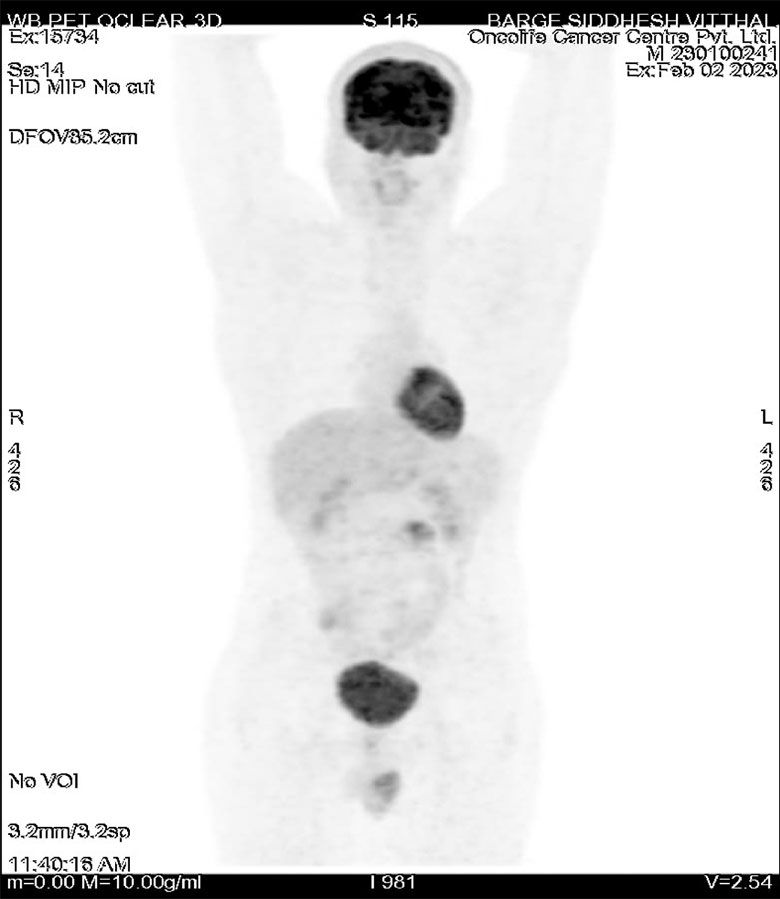
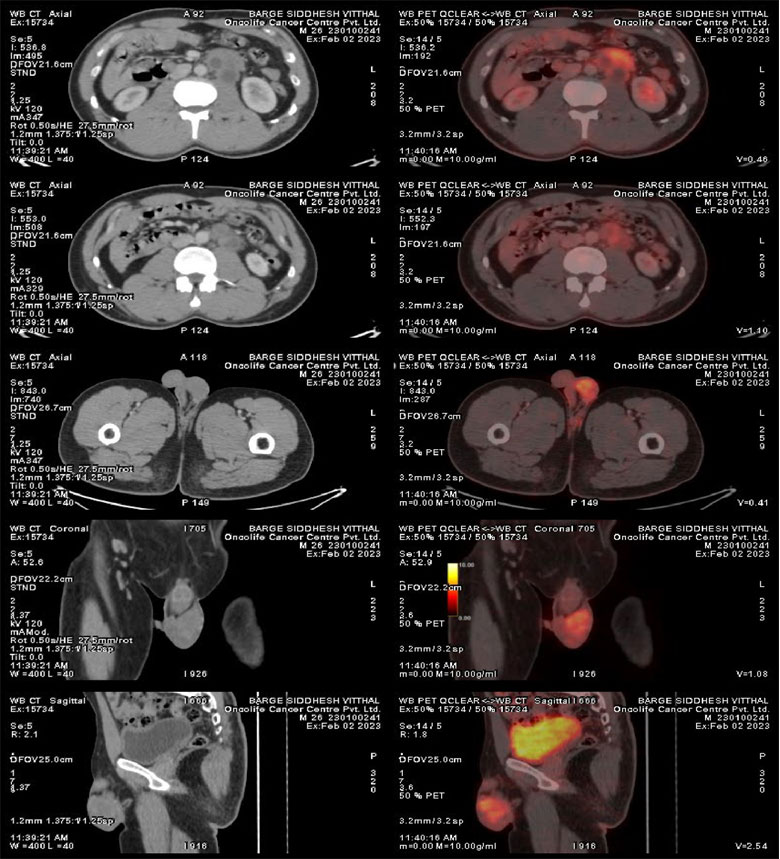
Patient underwent Surgery – High inguinal orchidectomy
Date – 06/02/2023
HPR- pT2:seminoma: LVI-present:mrgins-negative -germ cell neoplasia in situ
Post operative markers AFP-1.79, LDH -317, BETA HCG <2.0
Patient ewas then given chemotherapy BEP (Bleomycin, Etoposide, Cisplatin) 3 cycles every 21 days from 24/2/23 to 11/4/23
Post chemotherapy PET scan was done on 5/5/2023 s/o
No definite scan evidence of metabolically active residual/recurrent disease at operated site in scrotum on left side. Few necrotic lymph nodes at left paraaortic region, showing mild metabolism – residual metastatic disease. No other hypermetabolic malignant lesions elsewhere in the body. As compared to previous PET CT report dated 02/02/2023, left testis lesion is not visualised (postop status. There are significant decrease in size and metabolic activity of left paraaortic lymph node.


Discussion
Etiology
The exact etiology of seminoma remains undetermined. However, the following factors are associated with an increase in the risk of seminoma:
- History of Cryptorchidism (Undescended Testis): Risk of seminoma increases with the history of cryptorchidism. There is 10 to 40 times higher risk in patients with an undescended testis, 10% of the patients with cryptorchidism develop germ cell tumor. An abdominal testis usually develops seminoma while a testis surgically brought to the scrotum by orchiopexy is a non-seminomatous germ cell tumor.
- Environmental Exposure: Exposure to chemical compounds like organochlorines, polychlorinated biphenyls, polyvinyl chlorides, phthalates, marijuana, and tobacco is associated with an increased risk of seminoma or other germ cell tumors.
- Infections: History of mumps viral infection is related to increased risk of germ cell tumors.
- Others: Other factors include trauma, maternal estrogen exposure, family history of testicular tumors, intersex syndromes (insensitive androgen syndrome and gonadal dysgenesis), and history of cancer in the contralateral testicle.
- Genetics: Genetic changes in the form of amplification and deletions are seen in 12p11.2-p12.1 chromosomal regions. Coffey and colleagues demonstrated that only seminomas contain activating mutations of the KIT gene.